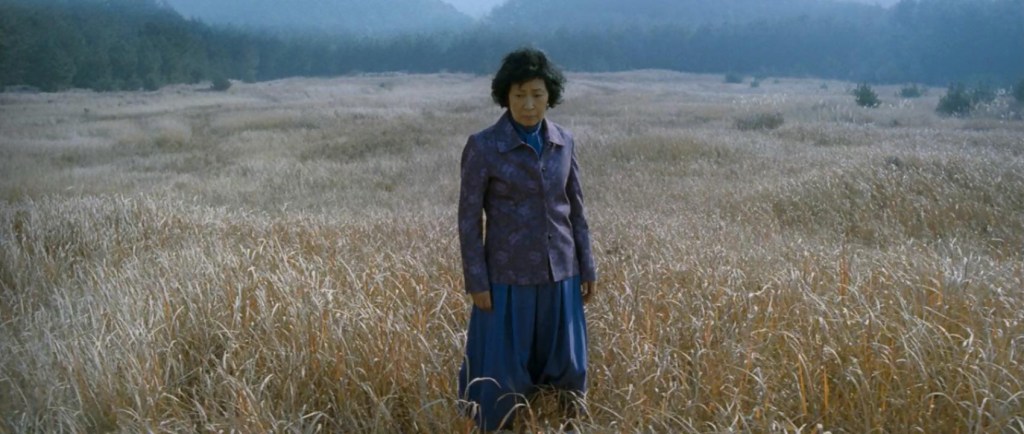
The first half can be said to largely inherit the merit of Memory of Murder, a construction in which the featured sequence extended in modifications has been demanding a convergence of occurrences that “otherwise remain as paralleled locutions.” But the narrative has diverged from that prototype since we viewing through the abandoned amusement park, where Bong stitches interactions that are asynchronous into a synchronized set and, thereafter, extends a quite abnormal – at least in Bong’s telling – happening: first we experience the intertwined orders with the son’s renewed memory around that dark night in which a strange, aged face glows in the deserted abode considered as the scene of the incident, and the mother’s desperate running on the other. Then, we see the latter reaching a different domesticity, which appears as ramshackle and uncanny as the murdered one. Inside the door, a stressed old woman, newly introduced, approaches the camera with a pressing velocity, a POV shot that vividly releases uneasiness by squeezing the distance between the viewer and the threatening figure who temporarily fails to be objectified. Following, an even more uninterpretable conversation between the mother and the aged myth is added to the occurrence, which references an eccentric logic about using the phone to exchange rice wine. The result is that the steadfast mother obtains the dead’s phone pulled out from a full rice jar, and the next scene cuts to the jail where she lets her son identify the photos in it.
Reviewing this elliptical driving, Bong nevertheless trims each fragment efficiently, making them contribute to a compact and smooth writing. Two key developments – a new participant within the murder (through the son’s re-sense), and a reversed character of the murdered (through the mother’s hunting search) – are finally converged thereupon. I won’t assert that Mother overweighs Memories in its techniques, but it indeed addresses me with a smarter pattern. It can still be remembered that in Memories how the detective plods are engendered from one assumption to another, delving into differentiated possibilities defensible in their respective expansions, however, at the cost of the “whole dynamic of the ontological murder.” Here, before characters enter the Ferris wheel, I was still concerned whether the girl’s death would be once more reduced to a syntactic fantasy whereby the director privileges the way of disengaging the fundamental constancy to form the extrapolation, yet based on a certain discoursal obligation. Nevertheless, instead of imitating the previous pattern, Bong has at this time retrieved the “authenticated center” as a consequence of accommodating the narrating mode with tangent cinematic grammar. Correspondingly, we are able to perceive the dynamic of motherhood therein by returning to its primitive event where the relation is unleashed symmetrically with no transference or compensation.
—— 2025.05.15
 Cinemyths
Leave a comment