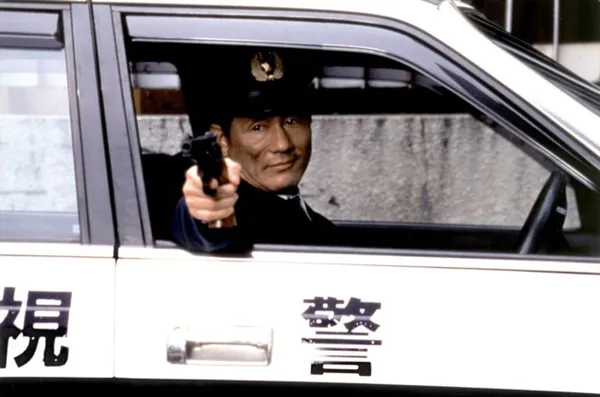
《花火》里依然存在北野武的游戏时间,充满破坏欲但又充盈着静谧,其中危机的运动永远消融在安逸的轮廓里。值得注意的是那些后拉的摇镜,逐渐呈现全景,由此在面或体中出现了“点”的入口——暗示“注视”发生在别处。尾声在四人场景中放入两颗子弹,镜头摇向大海,收于风筝女孩的目光中。摄影机“凝视”的客体发生变化,先前所有被凝视的死亡重新出现,两种状态间出现了关于“认同”的联系;生者与尸体间,那里有一段明媚的距离。
——
Kitano has a flair for making his image (qua movement) full of destructive play while maintaining every precarious process within a larger picture indicative of serenity. The tension generated by the procedural hazards of those gory moves is always defused by the cavalier nonchalance that pervades the situation.
I also noticed those pull-back shots in the film, which reveal the particular entrance in a plane by gradually disclosing its full landscape with an angular zoom-out. And by visually drawing out the extension of close violence, the camera succeeds in indicating the faculty of incarnated gaze as always held “elsewhere”. In the closing sequence of Fireworks, so to speak, when two bullets streak across the seaside scene featuring four figures, the camera then pans towards the sea, tapering into the innocent sight of the kite-flying girl. As the scene progresses, the protagonist bearing the camera’s gaze keeps shifting; the aligned contemplation recalls all previous deaths that occupy the same position, thereby bringing in a mutual identification that coalesces the live and the dead into one subject able to reflect both the camera’s empathic look and Kitano’s satirical fanaticism of romanticizing bloodshed while not veneering the brutal consequence of those acts ruining the somatic texture.
Another thing Kitano tells his audience is that killing does not have to be radically gruesome; the distance between life and death can be as bright as from the seashore to the ethereal horizon.
—— 2021.10.22
Leave a Reply