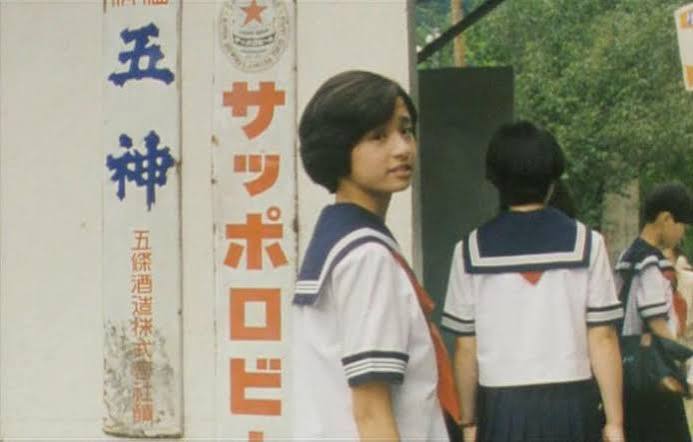
“山中一半雨,树杪百重泉”,不知过了多长时间又看到如此饱含事物冥灭的影像。当一些形象从摄影机前消失,它们的姿态上游至飘渺,构成某种“视觉的回响”在后来的时间重新被唤醒。而所有的一切皆寄托在一片白色的情绪之间向静谧的周遭淡淡扩散。于是,河濑直美制造了同阿彼察邦相似的转瞬奇幻。但当这样的梦隐拂过山林,只留下了极少的虚浮传说,更多的是水月鱼兽静听梵声,是“溪花与禅意,相对亦无言”的沉寂。
——
It has been a long while since I was last acknowledged in a film where things in their nature glow between immanence and evanescence. When those enigmatic figures disappear from Masaki Tamura’s camera, they evaporate rather than vanish. That is to say, Naomi Kawase is not intent on engendering apprehension through mythmaking; her every meditative stroke over ordinary recording makes the worldly objects otherwise sedimented in their customary pronunciations occasionally spirited away, and their estrangement is not radical at all, the realization of which often emits the dilatory echo complementary to the fathom of the mechanical visions afterwards, as though raindrops gradually penetrating a concrete ground yet preserving its concreteness.
We see things take place before our eyes. We know they are happening as surely as we know they are the reminiscence of a certain lost past, of the vast pastness within which the presence becomes present and reflexive. There are pensive silhouettes enclosing things’ appearances whenever a presence is given, and the impulse that raises such inky outlines is less bespoken by the intentional withdrawal of the subject’s history than by the genesis of being whose figure onscreen is any more than indiscriminate light if all the boundaries between objects are equally bright. Comparison arises accordingly: in Kurosawa’s precursor works, the single protagonist with his distinctively stern boundary often elegizes permanence; when there are boundaries multiplied and entangled in one glimpse, scopes being devastated only for being continuous, transience survives immortality, so has the surreal sensuality come. That’s what Kawase habitually considers in her works; instead of eternalizing a dominant legend, she reveals the legendary of variety.
But ironically, there is no emotional earnestness when the varying world pours its volatility down to us through Kawase’s capturing of its motion. We know the changes might sometimes be crucial and wounding, and we begin to understand vicissitude in its slightest degree; however, we can barely discern the uniformity in her restrained techniques to trim our empathy, and what the viewer encounters is often too breathing to commit a common sign. Nevertheless, in a faith that the world has naturally rejected any conclusion, the process of asserting is replaced with the peripatetic articulation toward the world at large, where the indeterminate becomes articulative to the world’s self-reference by simply exerting its indeterminacy, and such suspension represents no less than a fact, a candor. In this regard, it leads to almost the same point between our presumption of a world beset with myths and our viewing of a foggy mountain beset with weightless blossoms. Of course, one can take this as Kawase’s gifted transformation, but what also matters is the viewer’s wisdom in acceptance.
——2024.04.24
Leave a Reply